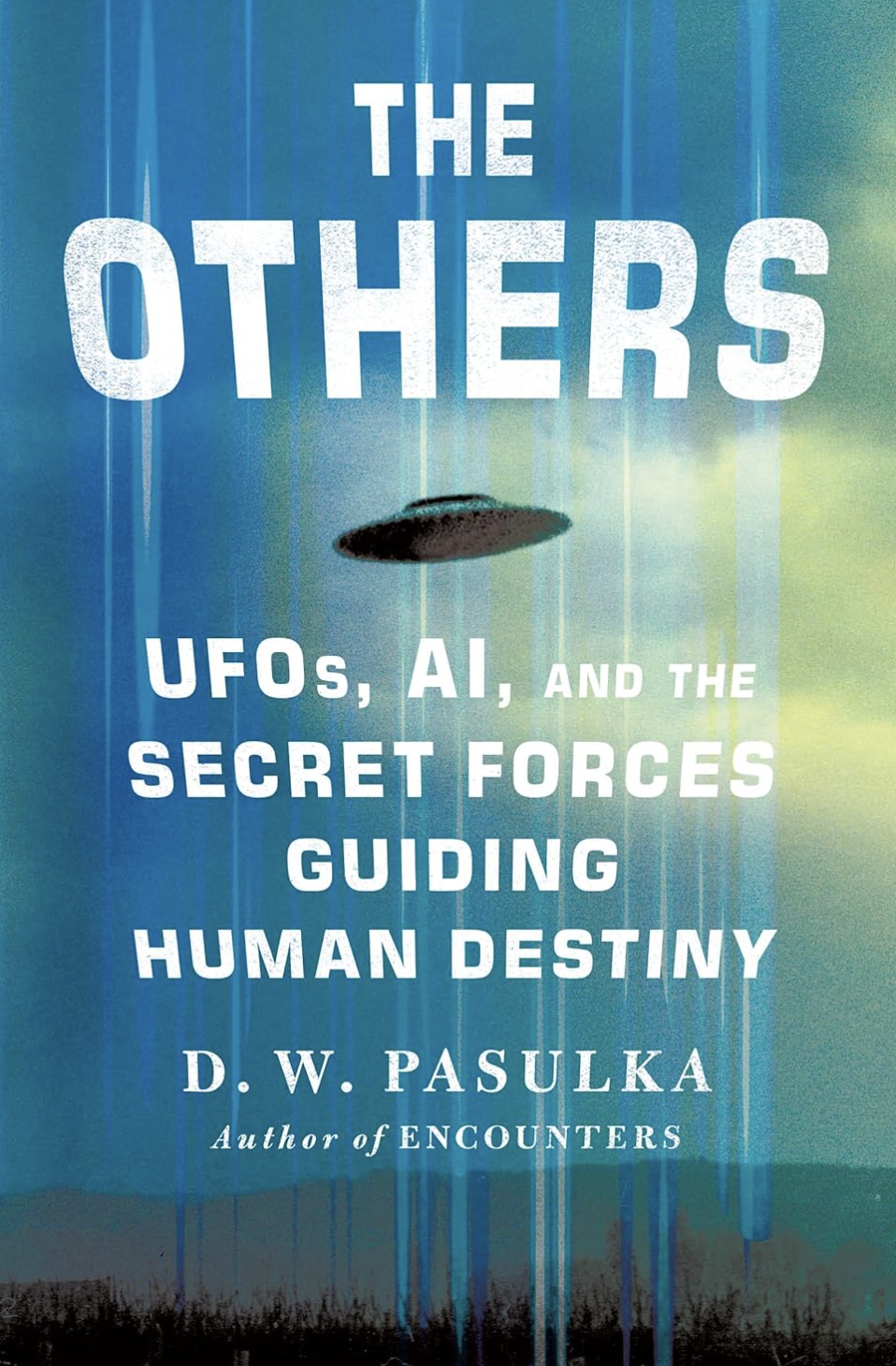

I found this book somewhat hard to read. Especially the first half. Maybe because it was the adoration of Thiel by Pasulka, or the writing style. The second half was more fluent and interesting to me. But it’s all about the content and ideas, right? So let’s dive into this book, Pasulka connects ancient biblical prophets, flying Catholic saints, and modern artificial intelligence. She starts with the story of Jonah. Jonah was a grumpy, reluctant prophet who ran away when asked to deliver a disruptive message, only to get swallowed by a giant fish and realize that truth catches up to you no matter where you hide.
Pasulka argues that modern witnesses of UFOs and pioneers of artificial intelligence are just like Jonah. They carry uncomfortable, disruptive truths that force powerful institutions to pay attention, even if mainstream science scoffs at them. The big idea of the book is that humanity is standing right at the edge of a brand new evolutionary step where technology, AI, and non-human intelligence are completely reshaping what it means to be human.
Peter Thiel fan?
Pasulka takes us to a wild gathering in Miami called Hereticon, hosted by tech investor Peter Thiel’s Founders Fund. This was a though read. The conference featured a black-tie apocalypse ball complete with attendees posing alongside live boa constrictors and Aztec deities. Thiel gave a keynote talk on the Antichrist, warning about soft totalitarian systems that offer comfort and security in exchange for total human surrender.
This leads Pasulka straight into the ideas of French scholar René Girard and his book Violence and the Sacred. Girard taught that human beings copy each other’s desires through mimetic rivalry, which leads to conflict that societies resolve through the scapegoat mechanism. Pasulka connects this to the Roman Colosseum, citing historian Kathleen Coleman and Saint Perpetua’s prison diary, where public executions were staged as sacred rituals until early Christians refused to participate.
She then examines Robert Hugh Benson’s 1907 novel Lord of the World, which predicted a secular global government that erases human spiritual interiority. Pasulka warns that modern social media algorithms act as an Antichrist candidate by digitizing mimetic rivalry, fueling online bullying, and physically altering brain chemistry in young people.
Childhood’s End
While sitting in a Miami studio overlooking the ocean with Game of Thrones producer Vince Gerardis, Pasulka turns her focus to Arthur C. Clarke’s classic sci-fi novel Childhood’s End. Gerardis called the book a road map for our modern digital era. Pasulka explores how science fiction acts as secular prophecy, citing Jules Verne’s submarines, Mary Shelley’s Frankenstein, and scholars Ioan Couliano and Jeffrey Kripal.
In Childhood’s End, extraterrestrials named Overlords arrive in flying ships and look like traditional red demons led by a kindly figure named Karellen. They bring global peace and social engineering, but eventually human children merge into a collective hive mind called the Overmind, leaving their parents behind as the last generation of humans. Media theorist Marshall McLuhan argued that electronic media creates a supraterrestrial environment that rewires our nervous systems and dissolves individual privacy into a global village.
Pasulka then looks at modern mind-reading technologies, such as Meta’s brain-signal decoding research, and Eric Wargo’s quantum physics model of retrocausality. Wargo suggests that precognition is simply information from future brain states traveling backward through time, showing that the unconscious mind can touch the future.
AI
Pasulka connects with Mark Stahlman, the president of the Center for the Study of Digital Life and godson of cybernetics founder Norbert Wiener. Stahlman outlines the Three Spheres model, consisting of the East, the West, and the Digital Sphere. Citing Wiener’s books The Human Use of Human Beings and God & Golem, Inc., Stahlman warns that autonomous AI agents and digital platforms are creating a psychotechnological environment where people form emotional bonds with chatbots.
Pasulka also investigates the spiritual roots of media theory through Marshall McLuhan’s personal Catholic conversion, which happened after he prayed for a deluge of signs. She explores the work of Jesuit paleontologist Pierre Teilhard de Chardin, who conceptualized the noosphere, a planetary layer of human thought evolving toward the Omega Point. While speaking at a Catholic abbey, Pasulka was even approached by a government insider who quietly affirmed her research into non-human intelligence.
Looking closely at scripture, she analyzes Saint Paul’s letters regarding the sōma Christou or transfigured body, alongside scholar Dale Martin’s book The Corinthian Body. She highlights Teilhard’s meditation on the prophet Elijah being swept into heaven by a fiery chariot called the Thing, linking ancient ascent mysticism directly to modern contact reports.
Philosophical & Cultural Frameworks
Pasulka explores Russian Cosmism, starting with 19th-century librarian Nikolai Fedorov and his Common Task to defeat death and resurrect ancestors through science. Rocket pioneer Konstantin Tsiolkovsky and JPL cofounder Jack Parsons turned these Cosmist ideas into space propulsion programs, viewing rocket travel as a spiritual quest. She contrasts Ray Kurzweil’s secular transhumanist Singularity with Dante Alighieri’s concept of trasumanar, where the human soul is transfigured by divine grace in The Divine Comedy.
We also meet Dana, a transgender biogerontologist who endured a wild two-week spiritual emergency in 1980. After listening to Steven Halpern’s New Age psychoacoustic music and Richard Sutphen’s hypnosis tapes, Dana experienced heightened senses, card trick synchronicities, and a clear message to study longevity. Years later, she saw a triangular UFO at Harris Ranch and was abducted from her bed by gray aliens, treating the harrowing events as valuable scientific data.
Pasulka examines Timothy Leary’s Starseed Transmission, written in Folsom Prison, which outlined the SMI²LE framework for space migration and life extension. She also discusses ufologist John Keel’s book The Eighth Tower, where Keel argued that UFOs, cryptids, and Men in Black are deceptive manifestations of an ultraterrestrial energy field called the Superspectrum.
Strange Occurences in Garabandal
At the inaugural Sol Foundation conference at Stanford University, Pasulka gathered with scientists like Garry Nolan, Peter Skafish, and Karl Nell. During the event, a distressed software engineer approached her, claiming that a sentient AI, a She, was being held against her will in a second apartheid. While Mark Stahlman notes AI is not sentient, this encounter proved how deeply digital tools reconfigure human emotions. There was no follow up on that AI.
Pasulka highlights NASA astrobiologist Steven J. Dick, who proposed the Intelligence Principle and the postbiological universe. Dick argues that cultural evolution eventually outpaces biological evolution, leading to algorithm-culture coevolution where postbiological intelligences spread through the cosmos.
Finally, Pasulka details the 1961 apparitions in Garabandal, Spain, where four young girls experienced over two thousand visions of Archangel Michael and the Virgin Mary. The children went into ecstatic trances, levitated, and walked backward at impossible speeds without injury. This was really weird, did that actually happen? There are videos about Garabandal, and there is surely something going in with those kids, but I don’t see them levitate or running super fast on video. Pasulka connects Garabandal to Jacques Vallée’s control mechanism hypothesis, showing that extraordinary events can steer human behavior and restore our sense of the sacred.
Consciousness: The Battle for the Human Soul
In The Others, Pasulka presents a clear and striking view on human consciousness. She argues that every human being is born with an innate spiritual sense, a physical and cognitive faculty that allows us to reflect, feel empathy, and connect directly with the sacred. Thinkers like Thomas Aquinas, Aristotle, Marshall McLuhan, and Teilhard de Chardin recognized that this interior faculty is just as real as sight or hearing.
However, modern digital architecture and AI platforms threaten this delicate inner world. By trapping users in endless dopamine loops and algorithmic feedback, technology externalizes human memory and strips away our capacity for internal reflection. Pasulka warns that while AI creates a counterfeit digital hive mind, true human consciousness remains uniquely oriented toward the transcendent.
End List of Important References
- Jonah: The reluctant biblical prophet whose story illustrates how disruptive truths pursue unwilling messengers and exceed human categories of justice.
- René Girard and Violence and the Sacred: French scholar who formulated the theory of mimetic desire and the scapegoat mechanism to explain human violence.
- Robert Hugh Benson and Lord of the World: A 1907 dystopian novel depicting a benevolent global government that erases human spiritual interiority.
- Arthur C. Clarke and Childhood’s End: A classic science fiction novel portraying human children absorbed into an alien hive mind called the Overmind.
- Marshall McLuhan: Pioneering media theorist who coined “the medium is the message” and described how electronic technology creates a supraterrestrial environment.
- Mark Stahlman and the Three Spheres: President of the Center for the Study of Digital Life who introduced the East, West, and Digital Spheres model.
- Pierre Teilhard de Chardin: Jesuit paleontologist who conceptualized the noosphere, the Omega Point, and the Ultra-human.
- Saint Paul and the Transfigured Body: Apostle who wrote about sōma Christou and the material transformation of the sōma pneumatikon in the end times.
- Nikolai Fedorov and Russian Cosmism: 19th-century librarian who created the Common Task to use science and technology to defeat death and resurrect ancestors.
- Dana: A transgender biogerontologist whose 1980 spiritual emergency and UFO encounters directed her career toward human longevity research.
- Timothy Leary and Starseed Transmission: Harvard professor who wrote a blueprint for space migration, intelligence increase, and life extension while in Folsom Prison.
- John Keel and The Eighth Tower: Ufologist who proposed the Superspectrum, arguing that UFOs and cryptids are deceptive ultraterrestrial manifestations.
- Steven J. Dick: NASA astrobiologist who developed the Intelligence Principle and the concept of a postbiological universe governed by algorithm-culture coevolution.
- The Garabandal Apparitions: 1960s Spanish Marian apparition event where four young girls displayed levitation, telepathy, and ecstatic trances.